
Application of Artificial Intelligence in Laparoscopic Training
Electronic poster titled “Application of Artificial Intelligence in Laparoscopic Training,” presented at the SESAM-2026 conference of the Society for Simulation Applied in Medicine (Lyon, France, June 19, 2026). The CV system achieved a 90–95% agreement with expert evaluations across all exercises.
Application of Artificial Intelligence in Laparoscopic Training
Maxim Gorshkov, MD, Dpil.Ec., MMSIm (Uni Graz), Prof. h.c.
EuroMedSim, European Institute for Simulation in Medicine
Electronic poster titled “Application of Artificial Intelligence in Laparoscopic Training,” presented at the SESAM-2026 conference of the Society for Simulation Applied in Medicine (Lyon, France, June 19, 2026).
Introduction
Training fundamental laparoscopic skills is a complex and time-consuming process. The Fundamentals of Laparoscopic Surgery (FLS) curriculum remains the gold standard for structured psychomotor training. However, continuous instructor supervision is required to ensure proper performance and feedback. A promising alternative is the use of computer vision (CV), subtype of artificial intelligence (AI) systems for automated, objective performance assessment in laparoscopic simulation. Aim was to develop and validate a computer vision–based system for automatic, objective evaluation of performance in basic laparoscopic skills tasks.
Methods and results
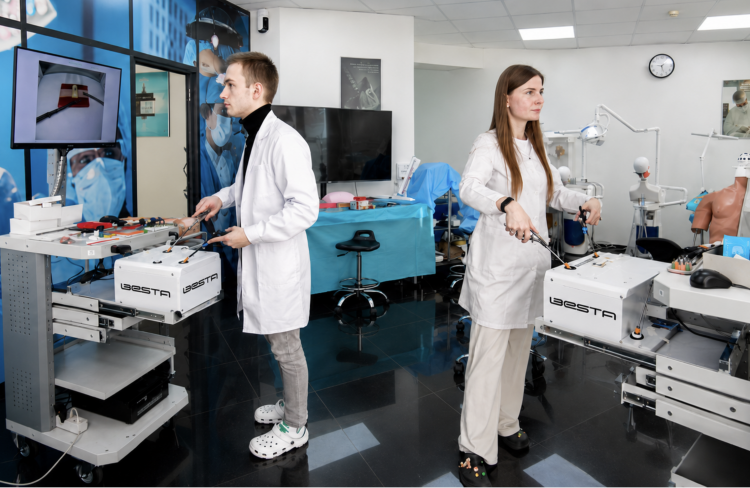
A real-time vision system with two synchronized cameras was integrated into a laparoscopic box trainer using standard laparoscopy tools and tasks devices. AI algorithms of the CV identified instruments, objects, and events (e.g., peg transfer, tissue cutting, endoloop) and computed quantitative parameters. CV models were trained on ~300 annotated training videos (≈50,000 labeled frames). A combination of classical computer vision and deep learning methods was applied in Python. Expert surgeons rated a validation dataset to serve as a gold standard.
The CV system achieved a 90–95% agreement with expert evaluations across all exercises, with minimal deviation in measured metrics (e.g., time, accuracy, trajectory). Performance improved markedly with larger and more diverse training datasets. The algorithms effectively detected key actions, instrument paths, and common errors in real time.
Discussion
The developed AI-driven vision system demonstrated high accuracy and reliability in assessing basic laparoscopic skills. It can substantially reduce instructor workload while providing objective, fast, and consistent feedback to learners, enhancing standardization in surgical education.
References
1. Fraser SA, Klassen DR, Feldman LS, Ghitulescu GA, Stanbridge D, Fried GM. Evaluating laparoscopic skills: setting the pass/fail score for the MISTELS system. Surg Endosc. 2003 Jun;17(6):964-7. doi:10.1007/s00464-002-8828-4. Epub 2003 Mar 28. PMID: 12658417.
2. Higgins RM, Turbati MS, Goldblatt MI. Preparing for and passing the fundamentals of laparoscopic surgery (FLS) exam improves general surgery resident operative performance and autonomy. Surg Endosc. 2023 Aug;37(8):6438-44. doi:10.1007/s00464-023-10124-8. Epub 2023 May 18. PMID: 37202525.